Compliance
Security guard certifications: the 2026 vendor-neutral map
A current overview of what you legally need to work as a security guard in 2026 across the US, UK and EU — plus the specialty certifications that actually move pay. Source-linked, with costs, expiry windows and the path that compounds.
- Author
- The Field Guide editorial team
- Published
- Published 2026-05-10
- Reading time
- 14 min read
1. The certification landscape in 2026
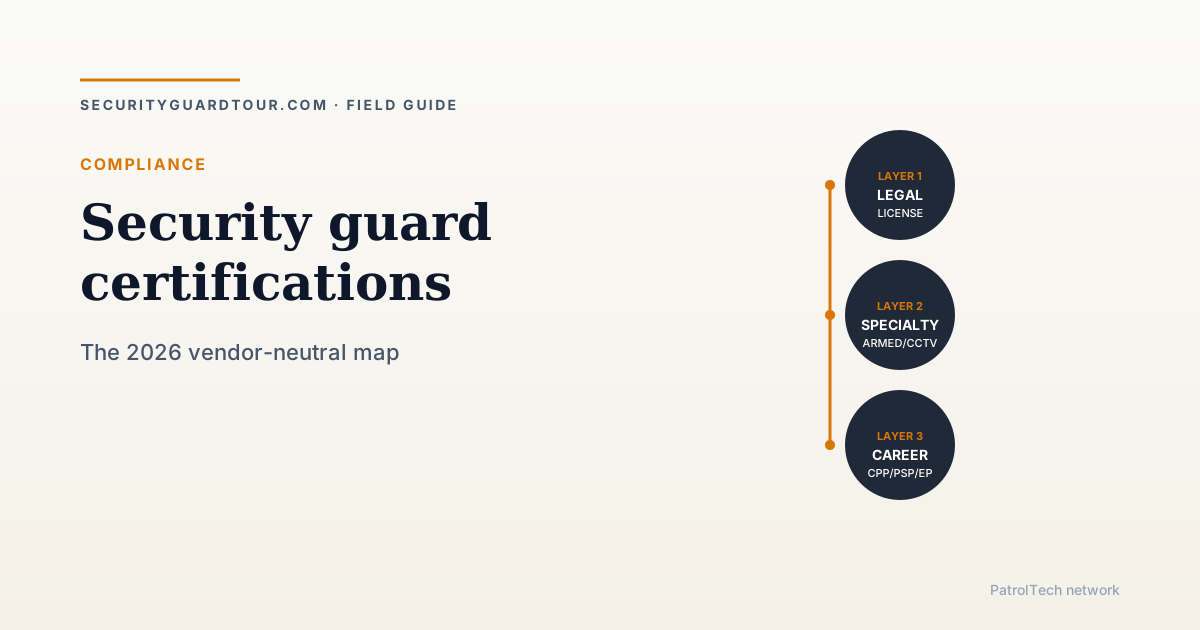
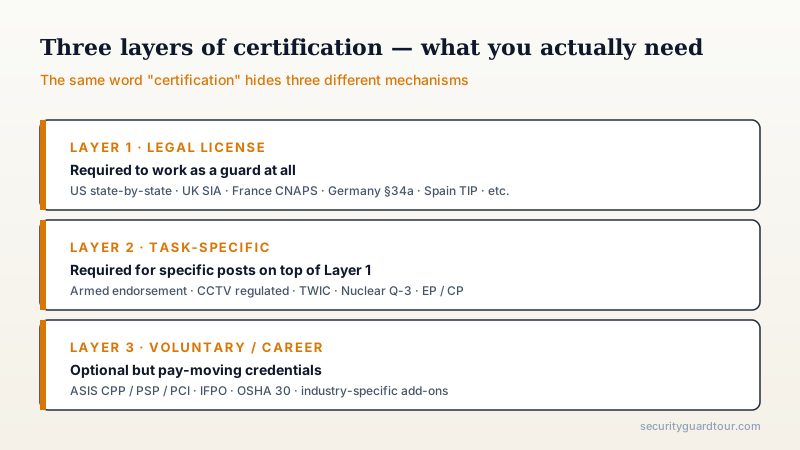
There is no global security guard certification. There is also no US national license. The phrase "security guard certification" hides three different layers that beginners and HR teams routinely confuse: **Layer 1 — the legal license to work.** This is jurisdiction-specific (state, country) and is the threshold to be a guard at all. In the US it is state-by-state. In the UK it is the SIA license. In the EU each member state has its own scheme. Without this license the role is illegal in most contexts. **Layer 2 — task-specific authorization.** This is the additional license needed to carry a firearm, drive armoured vehicles, work close protection, operate CCTV under regulated regimes, or work in nuclear, port or aviation. Layer 2 always sits on top of Layer 1 — you cannot be an armed guard without being a licensed guard first. **Layer 3 — voluntary professional certifications.** These are credentials offered by industry bodies (ASIS International, IFPO, OSHA) that signal experience and skill but are not legally required. They show up on resumes, move base pay, and are often required by specific corporate clients. Getting these three layers right is mostly a calendar exercise. Most renewals lapse not because the guard cannot pay or pass — it lapses because nobody tracked the date. Treat your stack of certifications as a renewals system, not as a one-time event.
2. United States — state-by-state in 2026
Of the 50 US states, 46 require a security guard license. The four that do not (Alabama, Colorado, Idaho, Mississippi) still typically require an employer-administered background check and pre-assignment training even though there is no state license to apply for. The four most demanding states by training hours and cost in 2026 are California (40-hour BSIS Guard Card, $50 + fingerprinting), New York (16-hour pre-assignment + 8-hour annual in-service), Florida (Class D 40-hour course, $145 application + $42 fingerprinting), and Texas (Level II Non-Commissioned Officer 6-hour + Level III for armed 30-hour). The four states with lowest hourly requirements (where a license still exists) are typically Pennsylvania (5 hours pre-assignment), Georgia (no state-mandated minimum hours pre-assignment beyond employer training), Oregon (12 hours classroom), and Washington (4 hours pre-assignment + 4 hours within 90 days). The most common pitfalls when a guard relocates or holds multiple state licenses: - **Reciprocity is rare.** California does not honor New York's pre-assignment hours. Most states require their own course even when the guard has been licensed for a decade elsewhere. - **Armed endorsements do not transfer.** A California Exposed Firearm Permit does not authorize armed work in Nevada — separate Nevada PILB armed permit required. - **Backgrounds are re-run.** Even with active license in one state, applying in another triggers a full FBI/state background check. Budget six to twelve weeks. - **Felony or domestic violence convictions block most state licenses,** with waiver processes that vary widely. Plan ahead if applicable. For accurate state-by-state details, consult each state's regulating agency directly: California BSIS, New York DOS, Florida DACS, Texas DPS PSB. The list below is current as of Q1 2026 but states amend their requirements at minimum annually, so we link to authoritative sources rather than mirror the data.
3. Specialty certifications that move pay
Beyond the state license, a small set of specialty certifications consistently move base pay in 2026. Each is described with its body, cost range, and the typical pay differential we have seen in deployments and contracts: **Armed endorsement (US, state-specific).** $200-450 initial including training and range qualification. Differential: +$3-8/hr versus unarmed in same site. **CPR / First Aid / AED (American Heart Association, American Red Cross).** $60-90 for a two-year card. Differential: low, but the lack of this is a disqualifier for most healthcare, sports venue and class-A office contracts. **CCTV operator under regulated regimes (UK SIA Public Space Surveillance, regulated US installations).** $300-600 initial. Differential: $2-5/hr; bigger effect is contract access, not hourly. **OSHA 10 / 30 (US).** $25-180. Differential: small per-hour, but required for industrial, construction-site, oil-and-gas, and many manufacturing contracts. **Executive Protection (multiple bodies — Esi, ICON, Pacific West, BSR).** $2,500-9,000 for a multi-week course. Differential: shifts career, not hourly — a credible EP credential puts the operator into a different market with $35-80/hr typical rates for protection details. **TWIC (Transportation Worker Identification Credential — US).** $125 for five years. Required for port, maritime and many transportation security roles. **Q-3 / Q-5 / EMR (US nuclear, NRC-regulated sites).** Site-administered, employer-paid. Differential: substantial — nuclear security pays $28-42/hr base. **ASIS Certified Protection Professional (CPP).** $200-450 testing fee + 7-year experience requirement. Differential: this is a management credential — moves a senior guard or supervisor into corporate security director paths with $90-150k salary range. The rule of thumb: one specialty cert added per year over five years, starting from the lowest-cost relevant one, produces a career path that compounds. Adding the same specialty as everyone else (just CPR and OSHA 10) does not.
4. United Kingdom — SIA license categories
The Security Industry Authority (SIA) license is the UK national license, valid in England, Wales, Scotland and Northern Ireland with minor cross-border differences. The license is category-specific: - **Security Guarding (Manned Guarding).** Static guarding, asset protection. Most common entry-level. 32 hours classroom training + first-aid + assessment. £196 license fee (3 years), £58.50 renewal. - **Door Supervisor.** Licensed premises with alcohol (pubs, clubs, festivals). Includes Manned Guarding scope plus physical intervention + conflict management modules. 53 hours training. - **Public Space Surveillance (CCTV).** Operating CCTV in regulated environments. 36 hours training. - **Close Protection.** Executive protection / bodyguarding. 150+ hours training, separate route, £196 license fee. - **Vehicle Immobiliser.** Releasing immobilized vehicles. Less common since 2012 changes. - **Cash and Valuables in Transit.** Money transport / armored cars. 14 hours training + Manned Guarding base. Key 2026 changes: the **SIA Top Up Training** requirement (introduced in 2021) means renewing license holders complete 4 hours of refreshed terror awareness and emergency response. The First Aid requirement (introduced 2021) is now de facto mandatory for new applicants and required at renewal. The SIA license check is searchable in real time at the SIA Register, and reputable employers verify before assignment. Forged licenses are still encountered annually and carry significant criminal penalties for both holder and employer.
5. European Union — fragmented but converging
EU regulation has not standardized private security licensing — each member state runs its own scheme. The most common in 2026: **France — CNAPS Aptitude Card.** The Conseil National des Activités Privées de Sécurité issues the carte professionnelle, required for any private security work. 175-hour CQP APS training course is the typical entry. Renewal every 5 years requires 31 hours of continuous training (MAC). Carte de qualification specific to ASA (airport surveillance) and ESPA (operator) are separate. Compliance with Convention Collective IDCC 1351 is also mandatory. **Germany — §34a Sachkundeprüfung.** The IHK (chamber of commerce) administers a sworn examination on relevant law (BGB, StGB, GewO, DSGVO), self-defense, and security procedures. Pass rate hovers around 50%. Specific armed work requires additional Waffenrechtliches Sachkundenachweis under BKA. **Spain — Vigilante de Seguridad (TIP).** Issued by Policía Nacional Unidad Central de Seguridad Privada. 240-hour course + Spanish nationality (or EU citizen with strict conditions) + physical/psychological aptitude tests. Specialized cards: Escolta Privado (close protection), Vigilante de Explosivos. Renewal every 5 years. **Italy — Guardia Particolare Giurata.** Sworn officer status issued by the Prefetto. Requires Italian citizenship (in practice), age 21, weapons license, regional training. Distinguishes from Guardia Giurata (industrial security). **Netherlands — ND/SVPB diploma.** Diploma Beveiliger administered by SVPB / Stichting Vakexamens. Required certification for any private security work, valid indefinitely with employer-sponsored refresher. **Convergence trend:** the European Commission has explored mutual recognition mechanisms but no binding directive has passed as of 2026. Cross-border security work (Frontex contractors, EU institution security) operates under specific contractual mechanisms rather than recognized national licenses.
6. The employer's view — what HR is actually checking
Most candidates focus on the entry license. HR teams in 2026 are typically checking five things, in order: **(1) Verified active license.** They check the state/SIA register directly, not just your card. Make sure your record is clean and current. A lapsed license (even 1 day) is a red flag in most ATS systems. **(2) Background check refresh.** Even with active license, many large contractors run a fresh check every 12 months and at change of assignment. Items they look at: prior felony convictions (most are blockers), domestic violence (most blockers), driving record (for vehicle posts), credit (only for armed and cash-handling roles, where state allows). **(3) Drug screen and physical.** Pre-employment plus random throughout employment. Cannabis remains a complicated variable — federally illegal in the US, legal in most states, but DOT-regulated roles and many corporate clients still require a negative result regardless of state law. **(4) Specialty stack matches the post.** Healthcare assignments check for valid CPR and de-escalation training. Armed posts check for current firearm qualification (some quarterly). EP work checks for credible course completion plus references. Tech-fluency on guard tour platforms, ACS and VMS is increasingly a checkbox during phone screens. **(5) References and tenure pattern.** A candidate with three 8-month tenures in two years gets more scrutiny than a candidate with two 3-year tenures, regardless of certifications. Stability matters for trust-based roles.
7. The career path that compounds in 2026
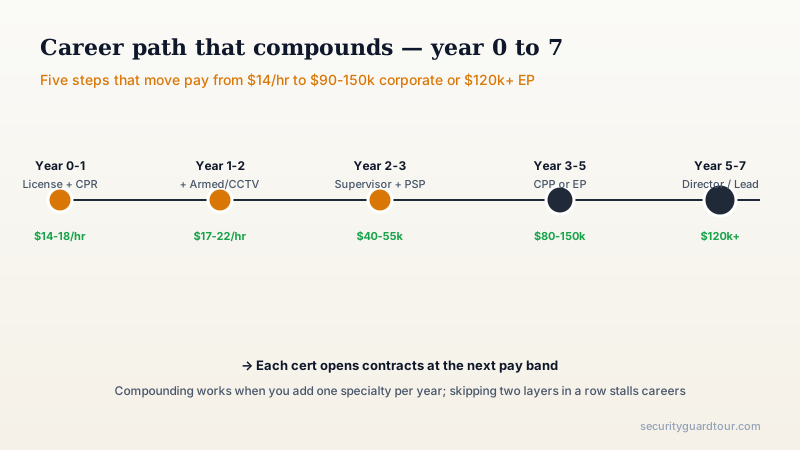
There is no single career path. There is, however, a pattern that consistently produces senior compensation by year 5-7: **Year 0-1.** State-mandated entry license + CPR/First Aid + OSHA 10. Base pay $14-18/hr. Take any shift assignment that exposes you to multiple verticals (corporate, healthcare, retail, residential). **Year 1-2.** Add armed endorsement OR CCTV operator OR healthcare specialty (depending on what your area pays). Now $17-22/hr. Start tracking incident-report quality and supervisor feedback — these become your case studies. **Year 2-3.** Move to supervisor or shift lead position. Add ASIS PSP (Physical Security Professional) preparation if going corporate, OR Executive Protection course if going protection track. Salary $40-55k. **Year 3-5.** Either: (a) ASIS CPP for corporate security director path with 5 years of senior individual contributor experience, or (b) credible EP credential plus first protection details for $80-150k/year track with travel. **Year 5-7.** Corporate Security Manager or Director ($85-140k) OR Protection Detail Lead ($120-220k) OR start your own contract company. The compounding mechanism: each specialty cert opens contracts at higher pay, the higher-pay contracts give you references and incident-handling stories, those stories pass ASIS-level peer review for advanced certifications, advanced certifications unlock leadership roles. Skipping any single layer is usually fine. Skipping two layers in a row is usually where careers stall.
8. How to choose your next certification — a simple framework
When deciding which certification to add next, three questions cut through the noise: **Where are you geographically and where will you be?** State-by-state mismatch is the biggest single career friction in the US. If you plan to move from Texas to California within 18 months, get the California license first (the BSIS Guard Card is accepted with proof of prior experience in some cases but still requires the California course); spending money on a Texas-only specialty cert before relocating wastes it. **What does the highest-paying contract in your area require?** Look at the top 10 job postings in your county for security guard roles in the past 90 days. Note the most-frequently-required certifications you do not yet have. That intersection is your next investment — not what the certification body markets to you, but what the local market actually pays for. **Does it open a new vertical?** A second cert in your current vertical (e.g. two corporate-security certs) gives you depth. A cert in a new vertical (e.g. corporate cert + healthcare CPR + medical-incident response) gives you breadth and access to more contracts. Breadth pays better in the first 5 years; depth pays better after year 10. The certification matrix is dense and changes faster than most career guides update. Bookmark the regulating agency for your jurisdiction, set calendar reminders 90 days before each renewal, and consult employers in your area on what they actually pay differentials for. Marketing brochures from training providers are the worst source of guidance — they sell certifications, not careers.