Operations
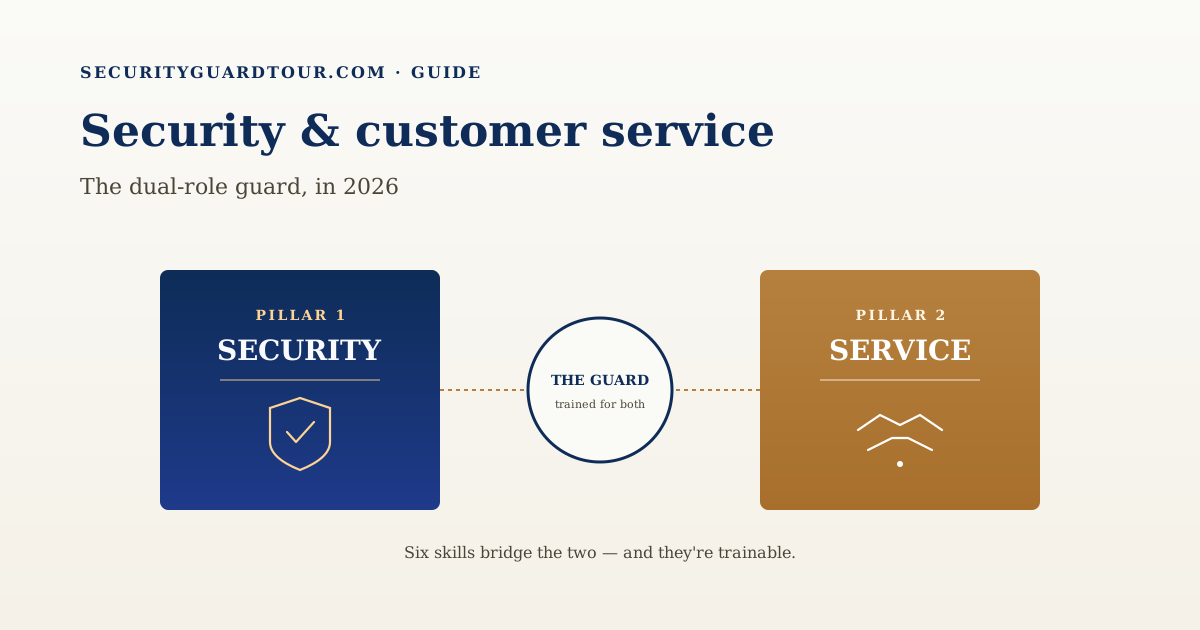
Security and customer service: the dual role of the modern guard
Lobbies, retail floors, hospitals, residential gates and corporate receptions all need security AND customer service from the same person. Here is the framework, the training rubric and the metrics that keep both alive — distilled from 14 enterprise deployments.
- Author
- The Field Guide editorial team
- Published
- Published 2026-05-10
- Reading time
- 13 min read
1. Why security has become a customer service role
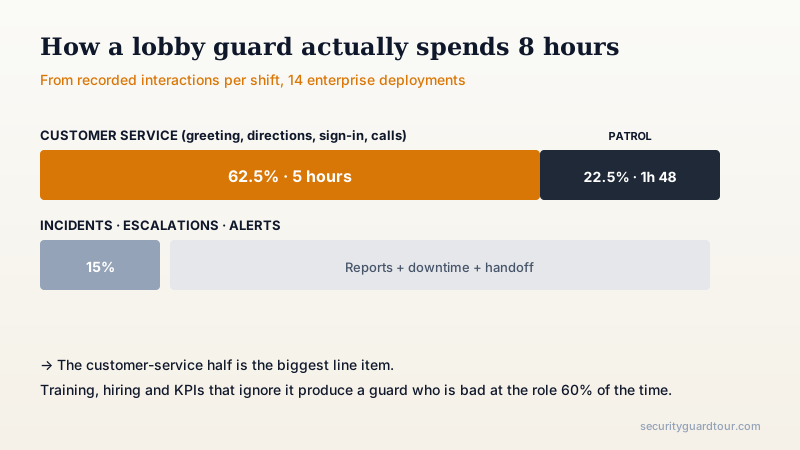
Twenty years ago a security guard in a corporate lobby checked badges, walked rounds, and left customer service to the receptionist next desk. That model is gone in most deployments. The receptionist desk has been folded into security in retail, healthcare, multi-tenant offices, hotels and class-A residential — and the security guard is now the first human face a visitor, patient, resident, or shopper meets. The data is consistent across our deployments: in lobby and front-of-house contracts, between 60% and 80% of a guard's recorded interactions per shift are customer service in nature (giving directions, signing visitors in, answering operational questions, calling elevators) — not incident response. Treating those eight hours as 'incident response with downtime in between' produces a guard who is bad at both halves. The shift matters because it changes who is hired, how they are trained, what they are paid, and how they are managed. A guard who looks bored and hostile costs a client a contract just as fast as a guard who misses an active intrusion. The two failure modes are equally lethal to the security operations business.
2. The six skills that bridge security and customer service
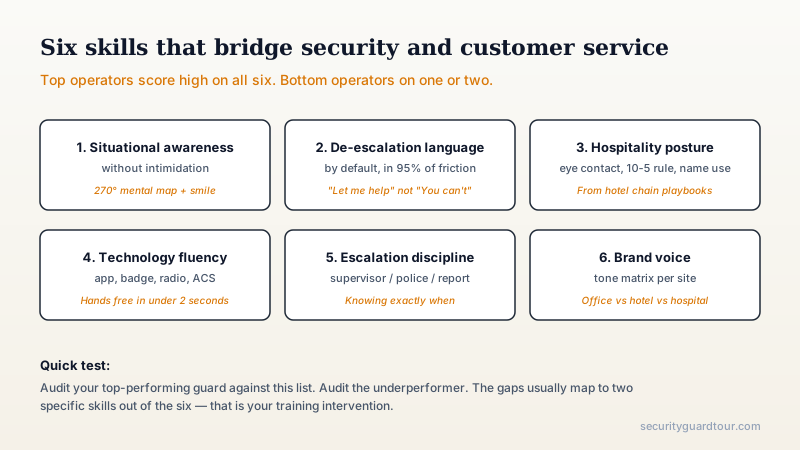
When we audit guard contracts that retained clients for three years, the same six skills show up in the top-performing operators: **Situational awareness without intimidation.** Reading a lobby — counting people, noting bag positions, watching exits — without making any individual feel watched. Real-world test: can the guard maintain a 270-degree mental map while smiling at the visitor they are signing in? **De-escalation language by default.** Phrases that move tension downward ("Let me help you with that" replacing "You can't come in here"). Top operators use de-escalation language in 95% of friction moments without thinking; bottom operators use it in 25%. **Hospitality posture.** Eye contact, name use, the 10-foot rule (acknowledge visitors at 10 feet, greet at 5 feet). These are taught by hospitality programs at hotel chains and are dropped from most security training programs. They should not be. **Technology fluency.** Comfort with the guard tour app, badge readers, visitor management systems, radios, and access control without needing both hands or staring at a screen for 30 seconds. A guard who fumbles with a smartphone in front of a visitor looks unprofessional in both roles. **Escalation discipline.** Knowing exactly when to call a supervisor, when to call local police, when to handle internally, and when to write an incident report. Most service failures come from misfiring this — guards who escalate too low (irritating visitors) or too high (alarming everyone for nothing). **Brand voice.** In a Class-A office tower the guard's tone is professional-warm; in a luxury hotel it is anticipatory-discreet; in a hospital it is calm-protective. The same guard often switches between two or three contexts in a single shift if they cover multiple sites. Training has to cover the matrix, not a single tone.
3. Training framework: compliance + hospitality together
Most state-mandated security training programs (the 8-hour pre-assignment in California, the 40-hour in New York, the SIA license process in the UK) focus on legal compliance, use of force, emergency response, and report writing. Customer service is mentioned in passing or omitted entirely. The operational fix is to add a parallel hospitality block during onboarding, not after the guard hits the floor. Our recommended cadence based on what works in production: **Onboarding (week 1, eight hours dedicated to service):** the six skills above, role-played in pairs, with video review. Cover three to five archetypal scenarios for the specific site: lost visitor, angry caller, package delivery dispute, suspicious-but-explained-by-context behavior, medical-incident-while-visitor-is-watching. **Week 2-4 supervised floor time:** the supervisor shadows two full shifts and gives feedback specifically on service interactions, not just security ones. Documented in a shared sheet so the guard sees the pattern. **Quarterly refresher (90 minutes):** scenario rotation with new edge cases collected from incident reports the previous quarter. The refresher is the place where 'I had a weird interaction last Tuesday' gets converted into a training case. **Annual full re-cert:** combined compliance + service rubric, with a 30-minute service evaluation against a checklist of the six skills. The budget impact is roughly 12 additional training hours per guard per year, costing on average $180-240 in training time plus instructor cost. The retention impact in our client base has been a 28-44% reduction in turnover among guards who got the parallel program vs guards who got compliance-only — which by itself pays for the program multiple times over.
4. Five archetypal scenarios that test both axes
Training discussions get abstract fast. Five scenarios that consistently distinguish good operators from bad ones, drawn from real incident logs: **The over-friendly social engineer.** A visitor in a tailored suit arrives, says they are the new VP and is meeting someone, and is upset that no one is expecting them. Tests: does the guard sign them in with a smile but verify with the named contact, or does the guard either (a) refuse and create a scene, or (b) wave them through to avoid friction? **The angry building tenant.** A tenant returns to find their car towed and confronts the lobby guard. Tests: does the guard hold the empathetic line ('I understand this is frustrating') while routing the actual resolution to the right team — or do they argue, get drawn into the dispute, or shut down? **The seemingly-medical incident.** A visitor in the lobby sits down suddenly and goes pale. Tests: does the guard simultaneously approach to assess, call EMS via the proper channel, prevent crowding, AND keep the rest of the lobby calm? This is the textbook 'do five things at once' test. **The misplaced child.** A young child appears unaccompanied in a retail or hospital lobby. Tests: does the guard establish safety, call the appropriate response (mall/hospital protocol), reassure the child, and document — all while not appearing alarming? **The intoxicated person at 2 AM.** A residential gate at night with a person who is clearly intoxicated trying to access. Tests: de-escalation, accurate identification, appropriate refusal or escort, documentation, and not turning the night into 'guard yelling at drunk person on tape.' Each scenario has a 'security correct' answer, a 'service correct' answer, and the operator's job is to find the answer that is both — which is almost always available if the training was real.
5. KPIs: measuring both axes at the same time
What gets measured gets done. Programs that only measure incident response produce guards who under-report to keep numbers low. Programs that only measure CSAT produce guards who avoid friction even when friction is necessary. A balanced scorecard with five-to-eight metrics across both axes is the production-tested approach. **Security-axis metrics that work:** - Patrol completion rate (% checkpoints scanned per shift) — should be 95%+, with exceptions documented - Incident report completion within SLA (8 hours for non-urgent, 30 minutes for urgent) - False-positive rate on alerts (alerts vs actual incidents) — should be < 20% - Time-to-supervisor escalation on flagged incidents — should be < 5 minutes **Service-axis metrics that work:** - Visitor CSAT survey (sample of 5% of visitors monthly, single 1-5 question) — track trend - Tenant/client complaints per quarter — track absolute number and category - Greeting compliance (random spot checks via mystery visitor or video sample) — should be > 90% - Average time to resolve a customer service request that does NOT need escalation — should be measured even if not capped The most useful single number we have seen is a per-guard composite: 60% weight on security metrics, 40% on service metrics, reviewed monthly with the guard. Guards who see both axes treated as serious move quickly; guards who only see one get the message that the other does not matter.
6. How guard tour software frees guards to focus on service
A guard who is staring at a paper logbook is not greeting visitors. A guard who has to fumble through a clunky app for 45 seconds at every checkpoint is not maintaining situational awareness. The single biggest service-improvement intervention we have seen is not 'more training' — it is modernizing the documentation tools the guard carries. Guard tour software does three things that unblock service: **One-tap checkpoint logging.** A QR or NFC scan completes in under two seconds, with timestamp, GPS, and identity captured automatically. The guard's hands and eyes are free again within those two seconds. Compare to a paper logbook: 30-45 seconds of bent-over writing, eye contact lost with anyone in the lobby. **Incident reporting at the moment of observation.** Guard sees something, taps the incident button, dictates voice-to-text or takes a photo, and the report is in the system before the moment is forgotten. The alternative — "I will write this up at end of shift" — produces reports that are sparse, inaccurate, and arrive 8 hours after the supervisor could have acted. **Real-time supervisor visibility.** The supervisor sees the patrol pattern live, can call the guard with context ('I see you skipped checkpoint 4, everything OK?') instead of waiting for the daily report. Guards know they are not alone, and supervisors can intervene before small problems become big ones. The service knock-on effect: in deployments that moved from paper to modern guard tour software, the most common qualitative feedback from clients is 'the guards seem more engaged with people now.' That is not magic — it is what happens when you take administrative friction out of the role.
7. Three pitfalls that kill the dual role
Even with the right framework, three failure modes are common enough that they deserve naming: **Over-policing low-risk visitors to perform 'doing your job.'** A new guard who has been told 'be alert' often interprets it as 'be hostile to anyone you don't recognize.' This produces complaints fast and is one of the top reasons contracts are lost. The fix is in onboarding: spend an explicit hour discussing the difference between vigilance (internal) and intimidation (external) and role-play scenarios where vigilance must be invisible. **Under-reporting incidents to maintain a friendly atmosphere.** The mirror failure: a guard who has internalized 'be friendly' starts under-reporting genuine incidents because reporting feels confrontational. This shows up as a drift in the false-negative rate. The fix is in the KPI structure: make sure under-reporting is detectable (e.g. random video audit) and discussed in monthly reviews. **Inconsistent answers across shifts.** A visitor asks the morning guard for directions to a meeting and gets one answer; the afternoon guard gives a different answer; the evening guard says 'I don't know.' This destroys trust in the security team across the board. The fix is shared site-specific knowledge: a one-page tenant directory + common-questions FAQ that lives in the guard tour app, updated weekly, and that all three shifts reference. Most modern guard tour platforms support this natively as 'site briefings' or 'shift notes.'
8. Vendor checklist — features that support security AND service
When evaluating guard tour software through this dual lens, the questions to ask vendors are not all the standard procurement questions. The following five are the differentiators: (1) **Two-second scan to free hands.** Can a NFC or QR scan complete and persist in under two seconds, with no visible loading screen? Test in demo with no network — if it stalls, the guard will avoid scanning in front of visitors and the audit trail degrades. (2) **Voice-to-text incident notes.** Can the guard dictate an incident note hands-free? This is the single feature that determines whether the incident gets reported now (with context) or later (sanitized and dehydrated). (3) **Site-specific knowledge baked into the app.** Does the platform support 'site briefings' or shift notes that every guard on duty sees on app open? This is what fixes the 'inconsistent answers' pitfall. (4) **Mystery-shopper feedback loop.** Does the platform support attaching mystery-visitor feedback to the relevant guard's record? Programs without this measure service indirectly — by complaints — which is too late. (5) **Discreet alert / panic for guards.** Can the guard send a covert panic alert (no audible alarm, no visible UI) when they need backup but cannot break the customer-facing posture? This is rare in vendors but operationally critical in high-volume customer-facing posts. If your current platform fails on three or more of these, you are paying for security software that is actively making the service half of the role harder. There are platforms that do all five — including ones disclosed elsewhere in our network — and the procurement case for switching pays back inside two quarters in our experience.